
What is a Welfare Footprint?
A common, evidence-based metric of animal welfare impacts — expressed as time spent in affective states, so experiences of different kinds, species, and systems can be compared on the same scale.
A quantitative measurement of impact on animal welfare.
A Welfare Footprint is a quantitative measurement of the impact that actions or processes across different sectors have on animal welfare. These sectors include, but are not limited to, industrial, commercial, agricultural, research, and natural processes.
Like in a life cycle analysis, a Welfare Footprint captures all welfare-relevant processes from birth to death for every animal involved — market animals, breeding stock, and ancillary species (e.g., fish used as feed).
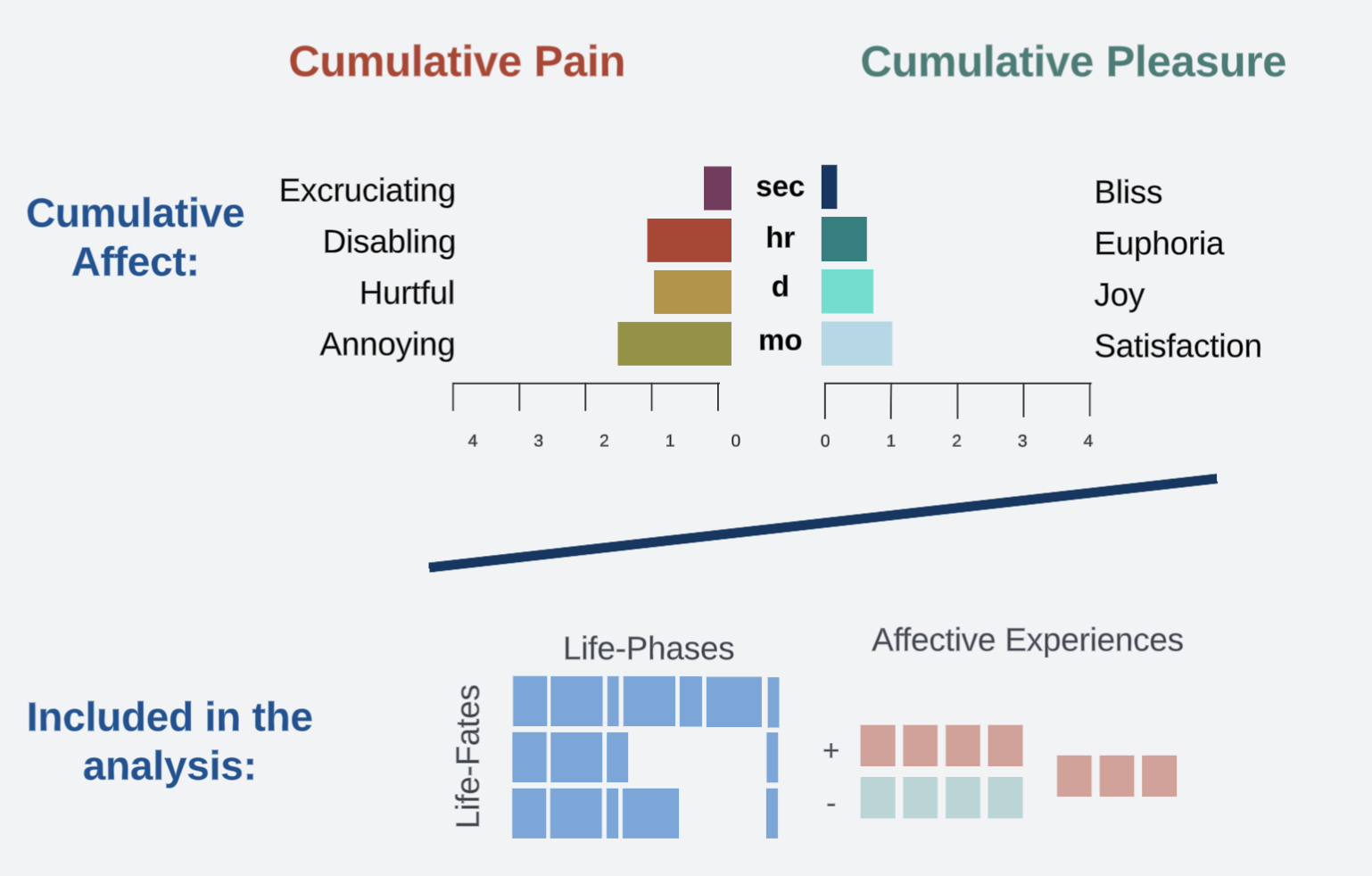
The metric quantifies three dimensions of each affective experience (such as physical pain from injuries and diseases, fear, frustration, and joy) that animals in a target population can experience over a defined period:
- Intensity: How unpleasant or pleasant each lived experience is (from Annoying to Excruciating; from Satisfaction to Bliss).
- Duration: How long each experience lasts.
- Prevalence: What proportion of animals experience it.
These dimensions are combined to calculate the total time spent in positive and negative states of varying intensities.
Results can be standardized per unit of product (e.g., 10 hours of severe Pain per kg of meat), per animal, per population, or per dollar spent — enabling direct comparison of welfare impacts between animal products, production methods, countries, companies, interventions, standards, or policy options.
A standard notation for a Welfare Footprint.
Welfare Footprints must be standardized to ensure comparability and transparency: estimates must specify the system (e.g., conventional, pasture-based), product (e.g., meat, eggs), species, and unit (e.g., per kilogram, per animal).
Estimates must always be accompanied by an explicit definition of the boundaries of the calculation, encompassing the Life-Fates considered (e.g., market animals, breeders), Life-Phases (e.g., rearing, growing, slaughter), and Affective Experiences assessed (e.g., Pain from lameness and frustration, Pleasure from social bonding).
Furthermore, the final notation must declare the assumption used for simultaneous states, stating whether the Cumulative Affect results are “strictly additive” or “adjusted for concurrent attention effects.” Without this specification, comparisons of estimates from assessments with different scopes — such as one including culled offspring and another excluding them — would be incommensurable. Uncertainty can be represented through the inclusion of ranges, distributions, or bars.
One metric, many denominators.
Results can be standardized per animal, per unit of product (e.g., kg of meat or dozen eggs), per person, per dollar spent — or per any other denominator that makes the comparison meaningful.
- Per animal
- Per kg of product
- Per person / diet
- Per dollar spent
- Per intervention
- Per policy scenario
A structured documentation of evidence.
Many welfare assessments combine welfare indicators and criteria, such as housing, health, behaviour, and mortality, into a score. These assessment tools are extremely useful for audits or certification, but the final score depends on which indicators are selected and how they are weighted. Importantly, scores are abstract, and scores produced for one system often cannot be meaningfully compared with scores produced for another.
A Welfare Footprint also uses welfare indicators, but as evidence about the presence, intensity and duration of affective experiences. The greater the number of validated indicators and lines of evidence about an experience, the greater the certainty about the presence and intensity of that experience.
The evidence behind every estimate is documented and can be updated.
Many welfare assessments ask experts to assign severity scores to conditions such as lameness, confinement, or heat stress. These scores can summarise an expert judgement, but the evidence and reasoning behind each value may be difficult to examine or revise.
A Welfare Footprint attributes probabilities to the presence and intensity of each Affective Experience based on a synthesis of existing evidence. Expert judgement is still required, but it is used to interpret the evidence documented. Judgments can always be traced back to the evidence supporting them. Individual estimates can always be checked, corrected, and updated as new evidence becomes available.