
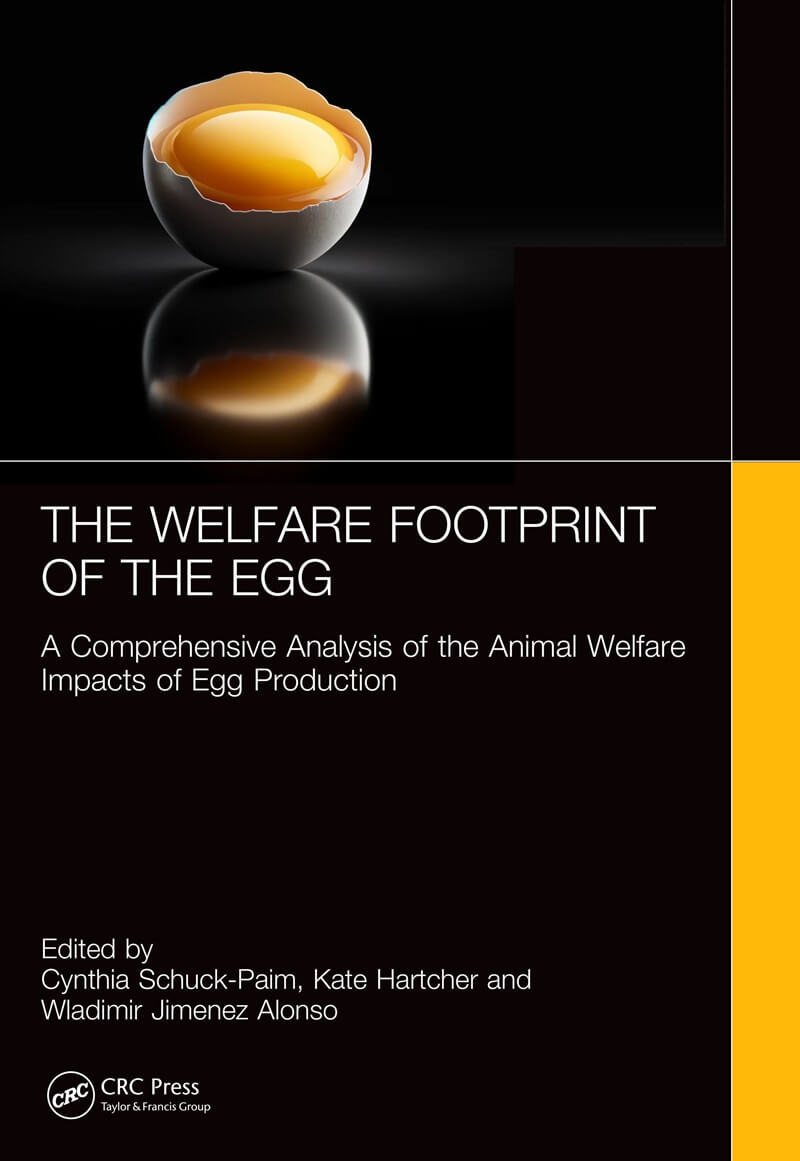
Forthcoming from CRC Press
The Welfare Footprint of the Egg
The first comprehensive quantification of animal welfare across the full lifecycle of an animal-sourced food product — from hatchery to slaughter — grounded in time-based, biologically meaningful units.
- 60+
- Contributing scientists
- 34
- Chapters
- 140
- Affective experiences analyzed
- 3
- Production systems
The first full Welfare Footprint of an animal-derived product.
The Welfare Footprint of the Egg is the first comprehensive quantification of animal welfare across the full lifecycle of an animal-sourced food product—from hatchery to slaughter. Applying the Welfare Footprint Framework, the book translates the lived experiences of laying hens, breeders, and male chicks into biologically grounded, quantitative metrics that are familiar to different audiences: the cumulative time they spend in affective states of varying intensity, including pain, fear, hunger, and frustration.
This work is the product of collaboration with over 60 leading poultry welfare scientists worldwide and offers a rigorous, decision-relevant assessment of welfare outcomes across major egg production systems: conventional cages, furnished cages, and cage-free systems. Each welfare challenge—whether physical injury, disease, behavioral restriction, or handling stress—is analyzed in terms of its intensity, duration, and prevalence, enabling multiple comparisons of welfare impact across practices, systems, and geographies.
Beyond establishing welfare footprints per egg, the project will provide detailed estimates of the welfare consequences of specific practices and reforms, such as bans on male chick culling, the adoption of new methods for mass depopulation, the critical role of early-life enrichment and positive welfare, and the impact of on-farm hatching practices. These findings clarify where—and how—animal welfare can be improved most effectively.
More than a reference text, The Welfare Footprint of the Egg advances the field of animal welfare science by introducing a common quantitative framework for assessing and comparing lived experiences across systems, species, and contexts. By grounding animal welfare in quantitative, biologically meaningful units, it enables integration of welfare impacts into economic models, food labeling systems, and public policy. It equips researchers with a common analytical framework, offers policymakers tools for regulation, and empowers industry actors and advocates to identify the most effective interventions .
This book also serves as a blueprint for applying welfare footprinting to other animal products—laying the scientific and institutional groundwork for a new class of welfare metrics, analogous in function and influence to Disability-Adjust-Life-Years (DALYs) and Quality-Adjusted-Life-Years (QALYs) in public health, or environmental footprints in the environmental sciences.
Four commercial systems
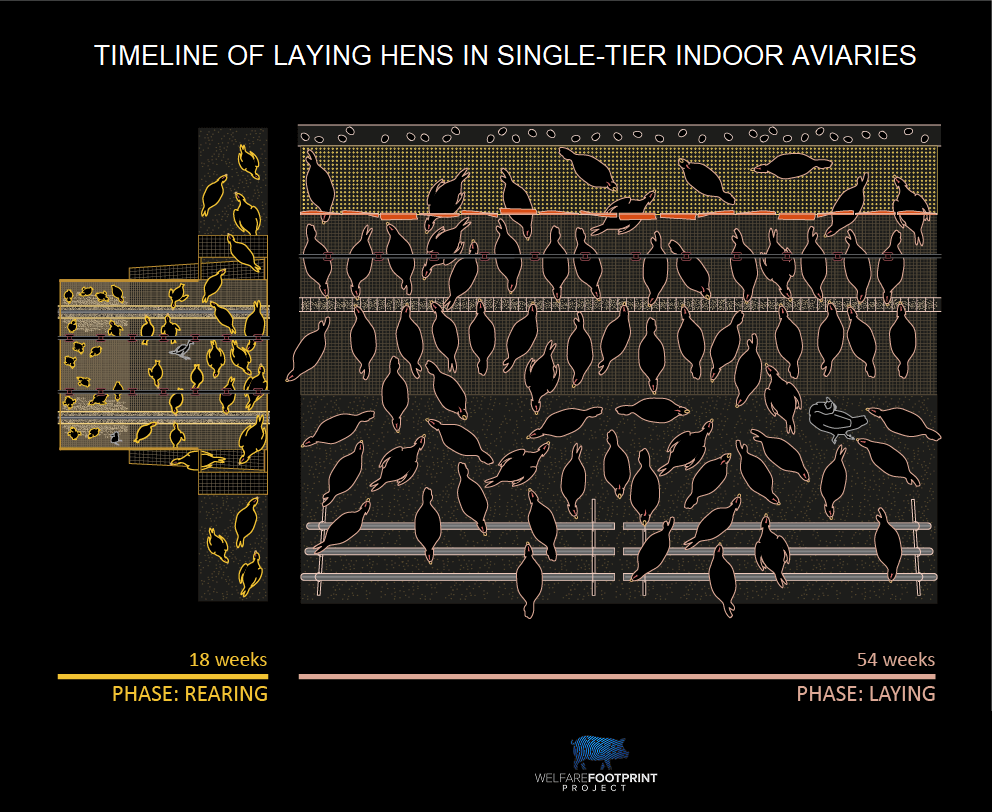
Single-tier aviary
Single usable level, floor litter, elevated perches and integrated nest boxes.
Table of contents
Each chapter lists its lead contributors and, where applicable, expands into the affective experiences it quantifies. Each experience opens its own analytical page.
A. Hatchery and early life
B. Developmental conditions
C. Infectious diseases
D. Tissue damage
E. Environmental stressors
F. Basic needs
G. Behavioral and social welfare
H. End of life
Over 60 leading poultry welfare scientists
Developed in collaboration with researchers from across academic, veterinary and welfare science communities worldwide. Listed alphabetically.
- Dr. Alessandra PiccirilloUniversity of Padua
- Dr. Amy MurilloUniversity of California
- Dr. Ashleigh Bright
- Prof. Dr. Bas RodenburgUtrecht University
- Prof. Dr. Christine NicolBristol University
- Dr. Courtney DaigleTexas A&M University
- Dr. Cynthia Schuck-PaimWelfare Footprint Institute
- Dr. Dana CampbellCSIRO
- Dr. Davide GiovinardiEuropean College of Poultry Veterinary Science
- Dr. Dean PowellGood Food Institute
- Dr. Deborah TempleUniversity of Barcelona
- Dr. Dominic WrightLinköping University
- Dr. Elsa Negro CalduchWelfare Footprint Institute
- Dr. Fernanda TahamtaniNorwegian Meat and Poultry Research Center
- Dr. Frank TuyttensGhent University
- Dr. Gwendolen Reyes-IllgAnimal Welfare Institute
- Dr. Gigi LinBC Ministry of Agriculture and Food
- Prof. Dr. Harry BlokhuisSwedish University of Agricultural Sciences
- MSc Hayley SutherlandPurdue University
- Prof. Dr. Ida ThøfnerUniversity of Copenhagen
- Dr. Inga TiemannOsnabrück University of Applied Sciences
- Dr. Ingrid de JongWageningen University
- Dr. Janice SiegfordMichigan State University
- Dr. Jasper HeerkensAeres University of Applied Sciences
- Prof. Dr. Jean-Loup RaultUniversity of Veterinary Medicine
- Prof. Dr. Jens Peter ChristensenUniversity of Copenhagen
- Dr. Jo EdgarBristol University
- Dr. Kaitlin WurtzWelfare Footprint Institute
- Dr. Kate HartcherWelfare Footprint Institute
- Dr. Kazim SahinFirat University
- Dr. Kyung-Woo LeeKonkuk University
- Dr. Leonie JacobsVirginia Tech
- Dr. Leisha Hewitt
- Prof. Dr. Linda J. KeelingSwedish University of Agricultural Sciences
- Dr. Louise HedlundLinköping University
- Dr. Maja MakagonUniversity of California
- Dr. Marisa ErasmusPurdue University
- Dr. Mia FernyhoughHumane League
- Dr. Mehdi ToghyaniUniversity of Sydney
- Dr. Mona GiersbergUtrecht University
- MSc Paula BakerBristol University
- Dr. Pol LlonchUniversity of Barcelona
- Dr. Prafulla RegmiUniversity of Georgia
- Dr. Rebecca NordquistUtrecht University
- Dr. Roos MolenaarWageningen University
- Prof. Dr. Ruth C. NewberryNorwegian University of Life Sciences
- Dr. Sabine Gebhardt-HenrichUniversity of Bern
- Dr. Sarah LambtonUniversity of Bristol
- Shay SadrUniversity of Sydney
- Prof. Stefan GunnarssonSwedish University of Agricultural Sciences
- Dr. Stephanie BuijsAgri-Food and Biosciences Institute
- Dr. Thea van NiekerkWageningen University
- Dr. Thi Thu Hao VanRMIT University
- Dr. Valentina BongiornoUniversity of Turin
- Dr. Vicky SandilandsScotland's Rural College
- Dr. Vivian GoerlichUtrecht University
- Dr. Wladimir J. AlonsoWelfare Footprint Institute
- Dr. Wendy MuirUniversity of Sydney
- Prof. Dr. Xavier MantecaUniversity of Barcelona
- Dr. Zack StrongAnimal Welfare Institute
The science of welfare footprinting: the Welfare Footprint of the Egg
The Welfare Footprint of the Egg was the focus of a dedicated full-day workshop at the 58th International Congress of the International Society for Applied Ethology (ISAE), held in Utrecht, the Netherlands.
On August 4th, 2025, the Welfare Footprint Institute hosted the satellite event “The Science of Welfare Footprinting: The Welfare Footprint of the Egg”, introducing the scientific community to the book’s methodology, and implications. This workshop was timed to engage researchers ahead of final manuscript submission. Through interactive sessions combining brief presentations, small-group discussions, and hands-on exercises, participants would:
- Learn how animal welfare footprints are established using cumulative, time-based metrics
- Explore methodological challenges in quantifying affective states
- Discuss key research gaps in poultry welfare
- Consider how welfare footprints can inform policy, sustainability assessments, and economic analysis
This event was intended to support early engagement with the scientific community and strengthen the academic impact of the book.