
Atlantic salmon welfare
Bridging Hatchery and Sea: Why Early Life Matters for Farmed Salmon Welfare
The industrialization of salmon aquaculture follows a pattern already familiar from land-based animal farming. The industry has intensified through selective breeding for rapid growth, accelerated growth protocols and high-density production. Productivity has risen, and so have welfare problems affecting hundreds of millions of animals every year. In broiler chickens, decades of focus on growth showed that remarkable productivity can coexist with widespread health and welfare problems. Salmon farming may be heading down a similar path.
Most welfare research, regulation and intervention in salmon farming focuses on the sea phase, called “grow-out.” That is where problems are most visible: sea lice infestations, disease outbreaks, stressful handling procedures and persistently high mortality. In Norway, the world’s largest producer, roughly 15–17% of farmed salmon at sea have died each year in recent years.
But what if some of the vulnerabilities behind these problems develop long before the fish reach the sea?
Our research explores how intensive hatchery conditions and practices may shape the health, welfare and resilience of farmed Atlantic salmon throughout their lives. It raises a simple question: are current hatchery practices designed primarily to produce fish that grow quickly, or fish that are physiologically prepared for the challenges they will face later?
Note: This presentation was delivered in 2025. As the research has continued to evolve since then, some details and interpretations may have been refined. The information presented in this page reflects our more recent understanding of the topic.
The overlooked half of salmon farming
Atlantic salmon spend a substantial part of their lives in freshwater hatcheries: typically 7–16 months, and sometimes more than 20 months in systems producing larger juveniles. In some production systems, this can be up to about half of their commercial lifespan. Yet welfare oversight and interventions have concentrated on the marine stage, where problems are most visible and economic losses most immediate.
Hatcheries are subject to legal requirements, but many additional welfare provisions depend on voluntary certification schemes. These standards commonly emphasise keeping environmental conditions within predefined thresholds and carrying out routine procedures in ways that minimise stress and injury. Such provisions are important, but they have limits. Keeping water conditions within acceptable ranges does not show whether fish are developing normally, whether their biological needs are met, or whether they will cope with what awaits them at sea. Freshwater and marine production are also usually assessed as separate stages, despite being biologically connected.
A fish can meet conventional hatchery health and production standards while carrying physiological vulnerabilities that only become apparent later in life.
Why early life deserves the spotlight
Early life is a sensitive period because many of the biological systems that support animals throughout their lives are still developing. The heart, skeleton, immune system, stress-response mechanisms and sensory organs all undergo important changes during this time. The conditions young animals experience can influence how these systems develop, with effects that may last long after those conditions have changed. This is known as developmental programming.
Some effects may be permanent, particularly when they involve the formation of organs and structures. Others, such as changes in immune regulation, stress responsiveness and behaviour, may be partially reversible or depend on later experiences.
A second concept, allostasis, describes how animals continually adjust their physiology to cope with changing demands. These adjustments cost energy. When challenges are prolonged or repeated, the cumulative burden, known as allostatic load, reduces the animal’s remaining capacity to respond to new stressors. If demands exceed that capacity, allostatic overload may occur.
A fish may therefore appear healthy under undemanding conditions but struggle when faced with sudden environmental change, disease or stressful handling. Its ability to cope depends not only on what it faces now, but also on its earlier experiences. Early life can also build physiological flexibility and resilience. The question is whether early rearing conditions support or constrain that process.
Why Atlantic salmon are a particularly important case
Beyond their long hatchery residency, Atlantic salmon go through one of the most demanding developmental transitions in aquaculture: smoltification. This is a coordinated transformation of hormones, metabolism, immune function and the organs that control salt and water balance (the gills, kidney and intestine), preparing young salmon for life at sea. In farming, its timing is controlled through hatchery practices, mainly artificial changes in day length.
Fish must then cope with handling, pumping and transport before entering seawater, where temperature, currents, oxygen levels and other conditions fluctuate continuously. All of this happens during a period of major physiological reorganisation, when their capacity to cope with additional challenges may already be strained.
What the evidence shows
Several observations suggest that what happens in the hatchery does not stay in the hatchery.
- Mortality peaks soon after transfer. Deaths at sea are not spread evenly. They spike in the first weeks after transfer, sometimes exceeding 4% per week. This early loss is largely accepted as a normal cost of production, and it is usually attributed to smolt quality, which is set in the hatchery.
- Fish that look the same can have different outcomes. In one study, salmon raised in two different freshwater systems were indistinguishable at transfer: same size, same condition, same standard readiness markers. Yet they differed in survival during the first month at sea, in how they adjusted to seawater, and in their final weight at harvest.
- Later deaths may also have hatchery roots. Mortality rises again later in the sea phase as fish undergo repeated stressful treatments. In one disease outbreak, 17 of 20 salmon that died after mechanical delousing had ruptured hearts. Their hearts had an abnormal shape linked to fast growth in the hatchery, while survivors from the same cage had more typical hearts. This is an association, not proof of cause, but it suggests that vulnerabilities set early may only show up later.
- Bigger is not necessarily better. The industry has increasingly kept fish longer in hatcheries so they go to sea larger. An analysis of more than 1,600 Norwegian groups of fish found no clear survival benefit from larger transfer size. Larger fish can also appear ready for seawater without having fully completed smoltification, which makes readiness harder to judge.
The environmental stability paradox
Modern salmon farming relies on a striking contrast between two environments. During early life, salmon are raised in highly controlled hatcheries, where temperature, lighting, water currents and feeding are carefully regulated to promote rapid growth and predictable production. They are then moved to open-net pens at sea, where conditions change constantly.
At sea, salmon must continuously weigh information about temperature, light, oxygen, currents, waves and perceived safety, among other cues. Barren, unchanging hatchery tanks pose no comparable decision-making problem.
The hypothesis we advance is that prolonged development under highly uniform conditions may constrain aspects of physiological, cognitive and behavioural flexibility, leaving fish less prepared for the variable demands of marine production. Several lines of evidence support this possibility, but studies tracking how specific hatchery conditions affect resilience across the full production cycle remain limited.
Cost of Faster Growth
Selective breeding has greatly increased the growth potential of farmed Atlantic salmon. Hatcheries accelerate growth further through relatively high temperatures, continuous light, and invariant water currents. These strategies produce larger fish in less time. But the conditions that maximise growth do not necessarily support the development of the systems needed to sustain it. Three aspects of intensive rearing stand out.
1. High, stable temperatures
Salmon are ectotherms: they cannot regulate their body temperature internally, so water temperature directly governs their metabolism, growth, activity and developmental timing.
Commercial hatcheries commonly keep water at relatively high (12–16 °C), stable temperatures to accelerate development and improve production efficiency. Yet the temperatures that promote the fastest growth are not necessarily those that best support the development of every organ and system. Accelerated growth under warmer rearing conditions has been linked to changes in heart development, weaker bone mineralisation, thinner skin and fewer muscle fibres. In brown trout, a close relative, aerobic capacity (the physiological reserve available to meet additional demands) declined progressively as constant temperatures increased. In Atlantic salmon, constant rearing temperatures have been associated with more aggression and fin damage than when fish could choose among different temperatures.
Temperature also provides seasonal cues. In nature, juvenile salmon reduce their activity in colder periods and become more active as water warms. A constant, relatively high temperature removes these signals and the opportunities for temperature-dependent adjustments in behaviour and metabolism that come with them.
What we don’t yet know: No study has tested whether controlled temperature variation in hatcheries makes salmon more robust at sea. Nor do we know what that variation should look like: how wide the range, how often it changes, at which life stages, or how to keep it from triggering early maturation or disrupting the biofilter bacteria that convert toxic ammonia from fish waste into less harmful compounds. These remain open questions that need testing.
2. Continuous light
Light is one of the most important signals regulating biological rhythms, including the release of hormones involved in stress, growth, metabolism and reproduction. In intensive hatcheries, artificial lighting often provides 24 hours of light per day. This promotes feeding, growth, reduces early sexual maturation and is also used to manipulate the timing of smoltification. In sea cages, artificial light is also used to further suppress sexual maturation, so farmed salmon may experience very little darkness throughout much of their lives.
Melatonin, a hormone released at night, is a key part of this system. In most fish, the pineal gland that produces melatonin contains its own internal clock, which keeps production rhythmic even without light cues. Salmonids lack this clock: their melatonin production directly follows darkness. Under continuous light, the nightly melatonin signal does not simply weaken; it disappears, with no internal rhythm to replace it.
Evidence from salmonids and other fish links continuous light to changes in immune function, metabolism and behaviour. The concern therefore goes beyond the absence of darkness itself. It is the removal of a fundamental cue that helps synchronise physiological processes and organise transitions between activity and rest.
What we don’t yet know: Much of the evidence linking continuous light to altered immune function comes from rainbow trout rather than Atlantic salmon. The long-term welfare consequences of sustained melatonin suppression and disrupted circadian rhythms in Atlantic salmon, including how fish experience prolonged light exposure, remain poorly understood. Another research priority is working out how periods of darkness can be built into hatchery protocols without increasing the risk of early sexual maturation.
3. Constant water currents
Water currents keep hatchery tanks working: they mix the water, deliver oxygen and remove waste. Moderate currents also encourage swimming, which can support muscle development, swimming performance and aspects of heart function, depending on intensity and duration.
In intensive hatcheries, water typically circulates continuously in one direction, often at about 1–1.5 body lengths per second. Fish can adapt by using energy-saving swimming strategies and areas of slower water within the tank. The concern is therefore not that salmon cannot rest, but that highly uniform conditions offer few opportunities or cues for meaningful transitions between activity and recovery. One study in rainbow trout suggests that intermittent exercise, with current speed raised for a few hours each day instead of held constant, may bring greater physiological benefits, including better heart performance under heat stress.
Direction matters too. Recent studies in related salmon species found that constant unidirectional flow was associated with uneven muscle development between the two sides of the body and more deformities in the otoliths. Otoliths are the inner-ear structures involved in hearing and balance, and these deformities can impair sensory function.
Programmes raising salmon for release into the wild have tested varying both current speed and direction as a form of environmental enrichment. Compared with conventional conditions, this improved foraging abilities and survival after release. Fish raised for restocking and fish destined for sea cages face different challenges, but both move from controlled hatchery conditions to far more dynamic environments. Structured variation in current speed and direction could therefore support not only physical development, but also the behavioural flexibility and resilience needed in open-net pens.
What we don’t yet know: The best current speeds for intermittent exercise at different stages of salmon development remain unclear, as do the most beneficial patterns for varying intensity, duration, frequency and direction. We also lack evidence on whether these approaches improve welfare, resilience and survival after transfer to sea. Their practical feasibility also needs assessment, particularly how changes in flow would affect water mixing, oxygen distribution, waste removal and overall system performance.
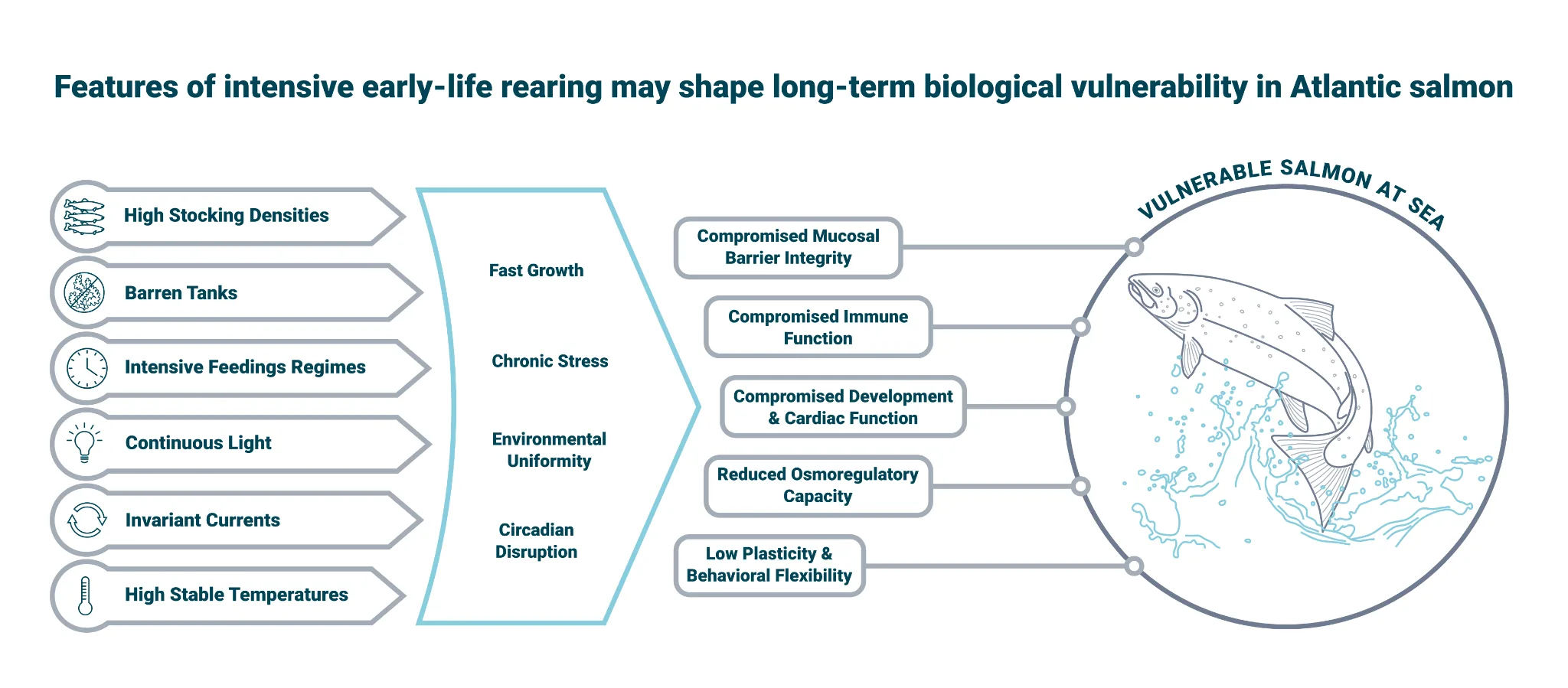
The combined effects of environmental uniformity
Temperature, light and currents are usually studied separately, but salmon experience them together, alongside high stocking densities, barren tanks and other hatchery stressors. Together, constant light, stable temperatures and invariant flow remove most of the environmental cues that normally organise daily patterns of activity and rest. Their combined effects may differ from those of any single factor. Understanding the cumulative burden of intensive rearing requires studying the rearing environment as a whole, which remains an important research gap.
Better welfare at sea may begin in the hatchery
The evidence points to two connected features of intensive hatchery production that deserve more attention: accelerated growth and the removal of environmental variation. Both can affect developing physiological systems, potentially creating vulnerabilities that stay hidden until fish face the more demanding conditions at sea.
This means the point at which a welfare problem becomes apparent is not necessarily the point at which its causes originated. Welfare assessments should therefore look beyond whether hatcheries maintain acceptable conditions, meet production targets or produce fish that look healthy at transfer. They should also ask whether fish are developing the capacity to cope with future challenges, with enough physiological reserve to respond to additional stressors.
Our research identifies several approaches worth investigating:
- Moderating growth rates: lower average rearing temperatures and more gradual growth, which may allow physiological systems to develop in a more coordinated way. Lower temperatures alone, however, do not address the potential consequences of keeping thermal conditions constant.
- Restoring rest-activity cycles: structured swimming exercise, periods of reduced current speed, and dark periods without feeding.
- Introducing controlled environmental variability: testing whether appropriate changes in temperature and water flow can support physiological flexibility and resilience.
These are research priorities, not ready-made commercial prescriptions. Their welfare benefits, feasibility and trade-offs need to be tested under realistic production conditions. The most important missing evidence will come from studies that follow identifiable groups of salmon from hatchery to harvest, linking early rearing conditions to later health, welfare and survival.
Further research is needed to quantify how much hatchery conditions contribute to welfare outcomes at sea. But the existing evidence gives strong reasons to investigate. Improving salmon welfare requires shifting from managing problems after they emerge toward understanding and preventing the developmental vulnerabilities that may contribute to them.
Common questions
Aren’t fish highly adaptable throughout their lives?
Fish keep considerable physiological flexibility throughout life. But this capacity to adjust is not unlimited, and it is also shaped by developmental history. Domestication has already changed it in farmed salmon. Compared with wild salmon, farmed salmon have shown weaker physiological responses to exercise training and less flexible gene activity in response to environmental change, an effect that may be stronger in simple, uniform environments. Changing less in response to the environment is not necessarily harmful in itself, but it raises a question. Fish that are already less responsive, and then raised in environments offering few opportunities to develop flexibility, may face added constraints when conditions change. The issue is not whether farmed salmon can acclimatise, but how their genetics and early experiences shape the range, effectiveness and cost of that acclimatisation.
Isn’t a stable temperature simply more comfortable for fish?
Stability removes thermal extremes, which can be beneficial. But wild salmon experience daily and seasonal temperature changes and use them to organise rest, activity and metabolism. Fish raised at constant temperatures may cope less well when temperatures later change, and salmon given a choice of temperatures move between them. Whether a stable temperature is “comfortable” depends on what the fish will face next, and farmed salmon go on to face a highly variable sea.
Don’t wild salmon also experience continuous daylight in summer?
At high northern latitudes, wild Atlantic salmon can experience near-continuous daylight for about two to four months in summer. But this exposure is seasonal, and wild fish can limit it: juveniles shelter under rocks and vegetation or move into deeper pools. In hatcheries, continuous light may last much longer, with little opportunity to avoid it, and supplementary lighting continues at sea. Even during long summer days, wild fish still experience other cues, such as temperature changes and food availability, that help organise their rhythms. Intensive rearing reduces those as well. Domestication has not removed the biological machinery that evolved to keep physiology in step with environmental cycles.
Don’t wild salmon swim at similar speeds anyway?
Reported cruising speeds are averages or periods of active swimming, not a speed held all day. Even during their seaward migration, when the drive to move is strongest, young salmon alternate active swimming with passive drifting and rest. Studies have recorded pauses of 3–12 hours, and migrating smolts may spend only 7–10% of their time swimming faster than the current. Constant swimming against an unchanging, unidirectional current has no direct equivalent in nature. The concern is not the speed itself, but the lack of variation.
If constant unidirectional currents may cause uneven development, wouldn’t producers have noticed?
Not necessarily. Subtle differences in muscle development and sensory function are not routinely measured in commercial hatcheries, so any contribution to problems later at sea could go unnoticed. The studies linking unidirectional currents to muscle asymmetry and otolith deformities appeared only in 2025–2026. The developmental effects of long-established practices can remain undetected until someone specifically looks for them.
Isn’t environmental variability only important for fish raised for restocking?
Much of the research on behavioural flexibility and adaptability comes from conservation and restocking programmes, where these capacities matter for survival after release. But the ability to cope with change is fundamental to physiology and welfare, whatever a fish’s life fate. Farmed salmon also make a major transition, from controlled hatcheries to open-net pens with fluctuating temperatures, currents and pathogens. The goal is not to make farmed salmon behave like wild fish, but to make sure early rearing supports the flexibility they will need throughout their lives.
Why do rest-activity cycles matter if we don’t know whether fish sleep?
Whether fish sleep the way mammals do is still debated. What is well established is that fish alternate between activity and rest. In brown trout, a close relative of Atlantic salmon, fish deprived of rest later showed more sleep-like behaviour, suggesting that rest is regulated by an internal need. In other animals, the need for sleep builds up while awake and is relieved during sleep. Restorative rest is therefore not simply inactivity; it is part of a cycle with the active period before it. Under uniform hatchery conditions, where light, temperature and currents barely change, the contrast between activity and recovery may become blurred. We hypothesise that this could affect how rest is regulated and how well it restores the animal, even if fish still have periods of reduced activity. Cycles of activity and rest are found across almost all animal groups and support energy conservation, tissue repair, metabolism, and cognitive and immune function.