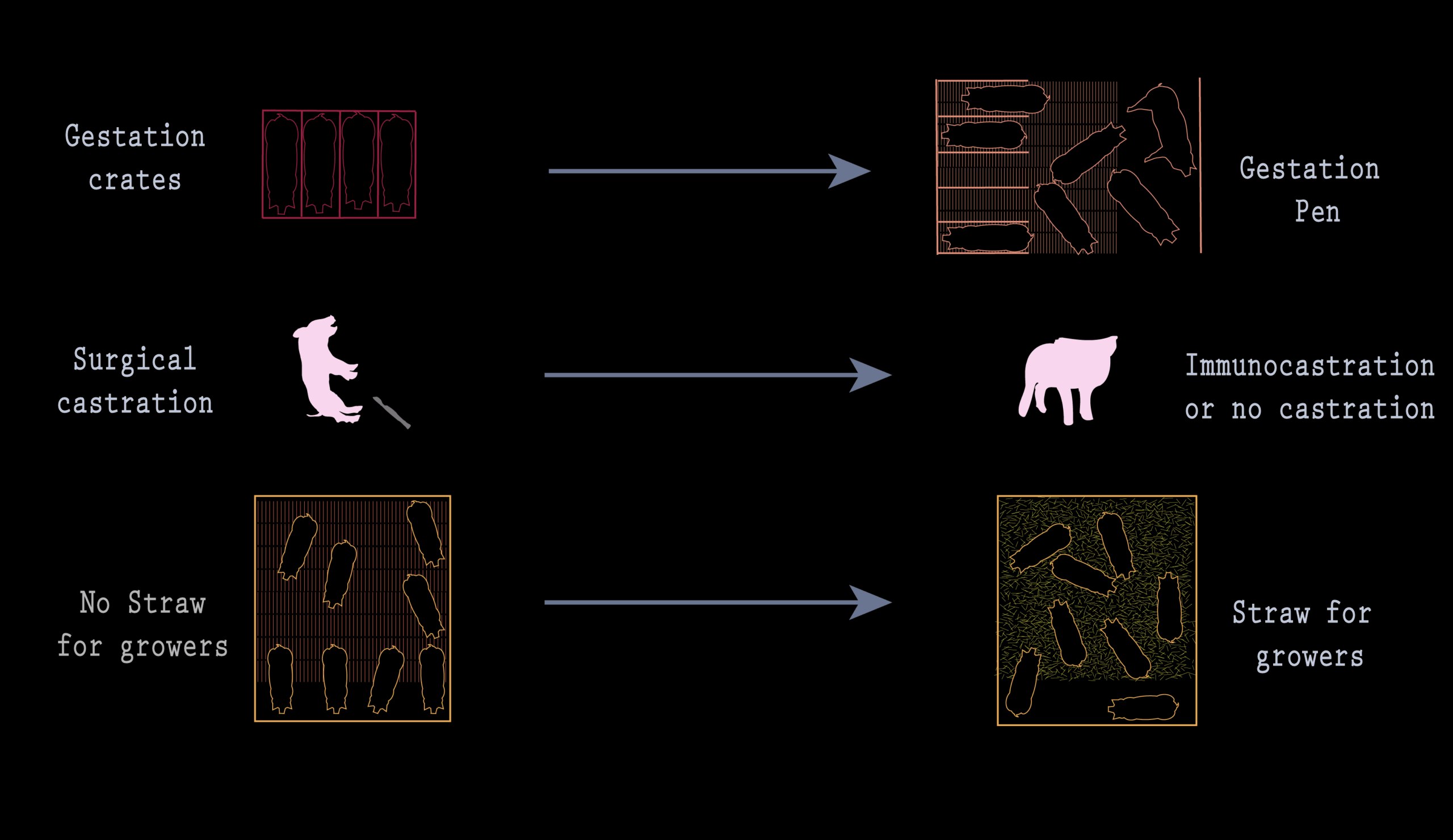
The following interventions have been identified as particularly relevant for their policy salience and potential to mitigate severe welfare compromises:
Elimination or restriction of gestation crate use for breeding sows. Two alternative group-gestation scenarios are considered: (1) sows are confined in crates for a limited period—four weeks post-conception and one week pre-farrowing—or (2) sows are housed in group systems throughout the entire gestation period. Both scenarios are compared to the current standard of prolonged individual confinement.
Cessation of surgical castration without analgesia. The analysis includes both the direct pain associated with the surgical procedure and the broader implications of this intervention for male pig welfare. Alternative practices, such as immunocastration or no intervention, are examined to estimate the net welfare gains.
Impact of early weaning practices. Commercial weaning often occurs around 21 days post-partum, a stage where piglets remain physiologically and behaviourally dependent on the sow. The welfare impact of early maternal separation is assessed in terms of the intensity and duration of negative affective states.
Provision of straw bedding for growing pigs. The availability of manipulable materials such as straw is known to support exploratory behaviour and reduce the incidence of behavioural frustration. This component of the project will quantify the welfare benefits of enhanced environmental complexity relative to barren housing conditions.
The Welfare Footprint Institute is currently seeking funding to carry out this analysis. The project will produce structured estimates of the magnitude of welfare impacts under current and alternative practices, providing a robust basis for prioritizing welfare reforms in pig production systems..