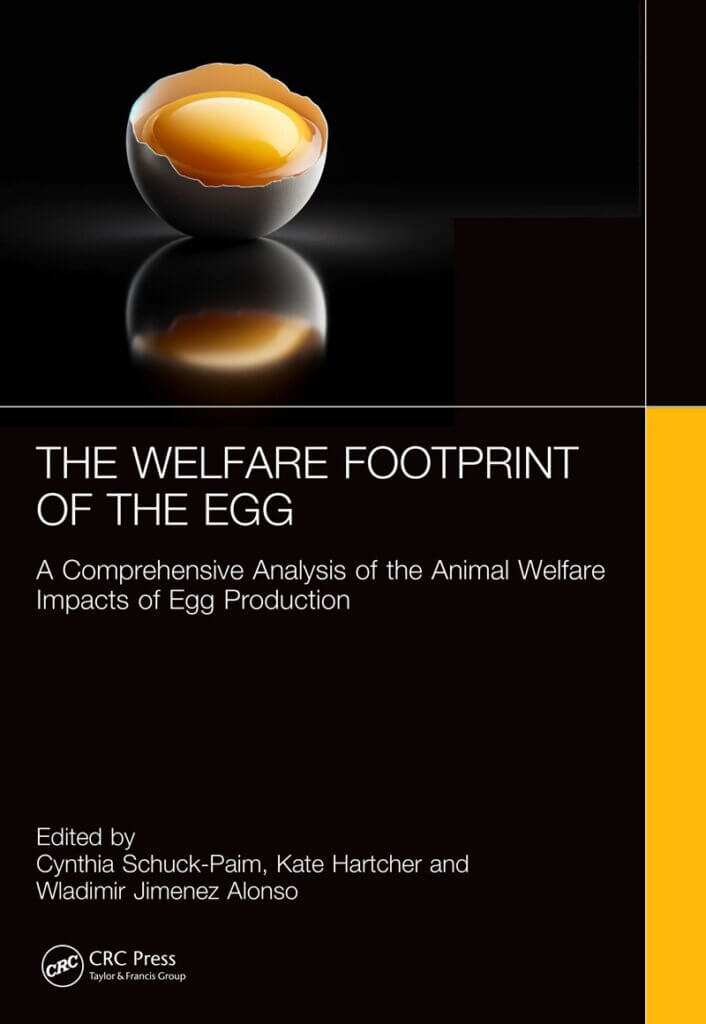
The Welfare Footprint of the Egg is the first comprehensive quantification of animal welfare across the full lifecycle of an animal-sourced food product—from hatchery to slaughter. Applying the Welfare Footprint Framework, the book translates the lived experiences of laying hens, breeders, and male chicks into biologically grounded, quantitative metrics that are familiar to different audiences: the cumulative time they spend in affective states of varying intensity, including pain, fear, hunger, and frustration.
This work is the product of collaboration with over 60 leading poultry welfare scientists worldwide and offers a rigorous, decision-relevant assessment of welfare outcomes across major egg production systems: conventional cages, furnished cages, and cage-free systems. Each welfare challenge—whether physical injury, disease, behavioral restriction, or handling stress—is analyzed in terms of its intensity, duration, and prevalence, enabling multiple comparisons of welfare impact across practices, systems, and geographies.
Beyond establishing welfare footprints per egg, the project will provide detailed estimates of the welfare consequences of specific practices and reforms, such as bans on male chick culling, the adoption of new methods for mass depopulation, the critical role of early-life enrichment and positive welfare, and the impact of on-farm hatching practices. These findings clarify where—and how—animal welfare can be improved most effectively.
More than a reference text, The Welfare Footprint of the Egg advances the field of animal welfare science by introducing a common quantitative framework for assessing and comparing lived experiences across systems, species, and contexts. By grounding animal welfare in quantitative, biologically meaningful units, it enables integration of welfare impacts into economic models, food labeling systems, and public policy. It equips researchers with a common analytical framework, offers policymakers tools for regulation, and empowers industry actors and advocates to identify the most effective interventions .
This book also serves as a blueprint for applying welfare footprinting to other animal products—laying the scientific and institutional groundwork for a new class of welfare metrics, analogous in function and influence to Disability-Adjust-Life-Years (DALYs) and Quality-Adjusted-Life-Years (QALYs) in public health, or environmental footprints in the environmental sciences.
Welfare Footprinting in Egg Production
— Quantifying animal welfare in Egg Production
— The Science of Welfare Footprinting: Framework and Methodology
Part I: Zootechnical Description
— The Egg Production Chain: Production Systems, Life Fates and Analytical Boundaries
— Mapping Circumstances in Egg Production: Key Living Conditions Affecting Animals
Part II: Veterinary Inventory
— Mapping Biological Consequences in Egg Production Systems
Part III: Affective Quantification
A. Hatchery and Early Life
– Early Life and Hatchery
– Transport to Farms
B. Developmental Conditions
— Osteoporosis
— Keel Bone Fractures
— Reproductive Diseases
— Metabolic Diseases
C. Infectious Diseases
— Diseases of the Digestive System
— Respiratory Diseases
— Ectoparasites and Mites
D. Tissue Damage
— Tissue Damage from Injurious Pecking
— Tissue Damage from Housing Equipment
— Inflammatory Skin Conditions
E. Environmental Stressors
— Thermal Environment
— Air Quality
F. Basic Needs
— Hunger & Thirst: Induced Molting
— Rest
G. Behavioral and Social Welfare
— Behavioral Needs
— Social Needs
— Fear and Anxiety
— Agency and Positive Affect
H. End of Life
— Pre-slaughter Mortality
— Depopulation and End-of-Life Transport
— Commercial Slaughter
— Euthanasia and Culling
— Whole Flock Emergency Killing
Part IV: Epidemiological Review
— Epidemiological Methods for Welfare Assessment
— Epidemiological Assessment of the Biological Consequences of Egg Production
Part V: Econometric Calculation
— The Welfare Footprint of the Egg
Future Directions
— Research Gaps in Laying Hen Welfare Science
— Alternative Egg Production
— Ethical Dimensions of Egg Production
— Future Directions
In Alphabetic order:
A blueprint for a science of animal welfare quantification
Establishes the first fully integrated framework to measure animal welfare in concrete, time-based units, enabling comparison across practices, products, and policies.
A paradigm shift for policy and economic analysis
Introduces metrics that allow animal welfare to be systematically integrated into policy design, cost-benefit evaluations, and sustainability frameworks.
A public-facing language for understanding animal welfare
Translates the experience of animals into minutes and hours of pain, fear, or pleasure—making welfare impacts visible and relatable to consumers, journalists, and decision-makers.
Quantification of the impact of major reforms
Provides decision-relevant estimates of the welfare effects of: – Cage vs. cage-free systems, – Mutilation bans (beak trimming), – Alternatives to male chick culling, – Hatchery practice improvements, – Slaughter and mass killing methods (e.g., avian influenza depopulation)
Systematic mapping of knowledge gaps
Identifies where data are lacking or incomplete—highlighting priority areas for research investment to improve the precision and reach of welfare assessments.
Foundation for assessing other animal-sourced foods
Demonstrates how the Welfare Footprint Framework can be applied to other products and species—laying the groundwork for a broader program of cross-species welfare accounting.
Academic convergence and field-building
Engages over 60 leading researchers in a coordinated application of the Welfare Footprint Framework, advancing a quantitative discipline within animal welfare science.
Policy, certification, and labeling readiness
Generates metrics designed for integration into regulatory policy, voluntary welfare standards, product labeling, and sustainability reporting systems.
Peer-reviewed publications on the implications of welfare reforms
This work is expected to generate peer-reviewed publications analyzing the implications of the quantified reforms—including cage-free transitions, mutilation bans, alternatives to male chick culling, improved hatchery conditions, and depopulation practices. By grounding welfare reform evaluation in empirical, comparative terms, these studies aim to shape both academic discourse and applied strategies for improving welfare in food systems.
The Welfare Footprint of the Egg will be the focus of a dedicated full-day workshop at the 58th International Congress of the International Society for Applied Ethology (ISAE), to be held in Utrecht, the Netherlands.
On August 4th, 2025, the Welfare Footprint Institute will host the satellite event “The Science of Welfare Footprinting: The Welfare Footprint of the Egg”, introducing the scientific community to the book’s methodology, and implications. This workshop is timed to engage researchers ahead of final manuscript submission. Through interactive sessions combining brief presentations, small-group discussions, and hands-on exercises, participants will:
This event will support early engagement with the scientific community and strengthen the academic impact of the book.