This page provides resources and detailed protocols to help researchers and practitioners apply the Cumulative Pain metric to their research questions. It is structured around four key analytical milestones, as illustrated below.
Note: We are currently updating the protocols to simplify terminology and fully standardize the method. Thank you for your patience—if you notice any inconsistencies, please let us know so we can address them promptly.
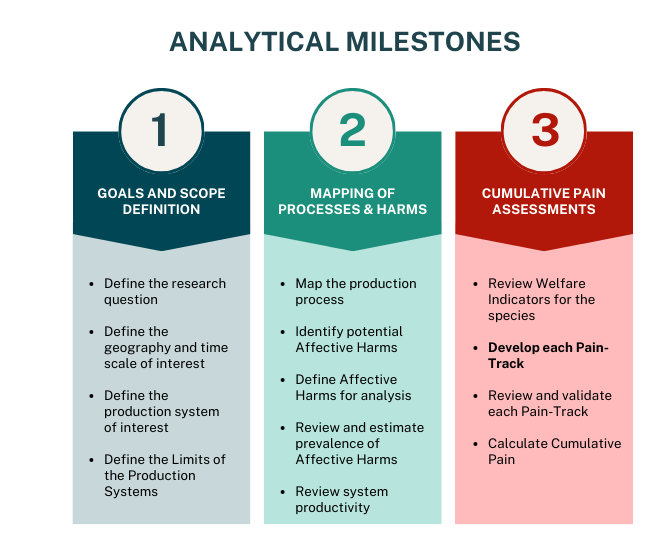
The first two milestones (1. Goal and Scope Definition, 2. Mapping of Processes) can be used by researchers using any welfare assessment method, as the protocols in these milestones can help identify relevant Circumstances that generate Biological Consequences, that results in Affective Experiences in animals in any production context.
This page will be continuously updated as new protocols and material becomes available.
Protocol for Defining the Goals and Scope of Analysis
This protocol is designed to guide researchers, organizations, policy-makers, and industry stakeholders in systematically establishing the goal and scope for welfare assessments, including the definition of the research question, the temporal and spatial scale, the production systems of interest and their limits.
Animal production systems encompass various production stages and practices where opportunities to either cause or prevent harm to animal welfare arise. Gaining a deep understanding of these systems and their typical variability is crucial to create a comprehensive map of potential Biological Consequences and resulting Affective Experiences and estimate their likely prevalence, duration and severity.
Protocol to Mapping Animal Production Systems and Biological Consequences
We recommend using process flowcharts to dissect animal production systems. By highlighting distinct paths, it facilitates a deeper understanding of these processes and their varying impacts on animal welfare .
Different life phases pose distinct challenges. We suggest using diagrams to map these Circumstances and their interactions for a specific Life Phase, helping identify and assess their welfare impacts.
Protocol for Identifying and Selecting Affective Experiences
Certain Affective Experiences can exhibit significant variations in severity and/or duration. This protocol is designed to help researchers in the choice of Affective Experiences and the corresponding Pain-Tracks (or Pleasure Tracks) that will quantify the magnitude of Pain (or Pleasure) experienced as a consequence in different Circumstances.
The main task in this Milestone, and the heart of Cumulative Pain assessment, is the development of one Pain-Track for each Negative Affective Experience (synonymous with ‘Pain’ in our operational definition), which involves developing hypotheses for the intensity and duration of each of the affective experiences identified in the previous sections. This is a critical task, likely to be the most laborious and time-consuming stage of the entire analytical process.
The approach is detailed in the first chapter of the book, ‘Quantifying Pain in Laying Hens: A Blueprint for the Comparative Analysis of Welfare in Animals’. The Pain-Track notation tool, an essential part of this framework, is described in a scientific paper that primarily addresses human pain in the medical field. For additional information, please refer to the answers to frequently asked questions.
If you are interested in further in-depth training, or discussing your research question with us, you can book a Virtual Office Hour session, or directly apply for a workshop (offered in flexible formats and durations, tailored to each specific need).