The Welfare Footprint Framework (WFF) is a method developed to quantify animal welfare by systematically measuring animals’ affective experiences—specifically, the intensity and duration of their negative (painful) and positive (pleasurable) states. It uses tools designed to capture the full diversity and complexity of animals’ experiences within different environments and production systems, explicitly considering different life stages, environmental and housing conditions, and management practices.
This comprehensive approach required the development of innovative concepts such as Life-Fates, Pain-Track, and Cumulative Pain, which also have relevance beyond the framework itself. The Welfare Footprint provides a transparent and evidence-based metric for objectively evaluating and comparing the welfare impacts of interventions, production systems, and animal-derived products. It can inform regulatory standards, certifications, investments, best practices and consumer choices—facilitating welfare improvements wherever animals are present – in food systems and other sectors.
The method was developed by scientists Wladimir J. Alonso and Cynthia Schuck-Paim, and is currently being applied to quantify the welfare impacts of several animal welfare reforms and animal-sourced products—most notably egg production, through collaboration with over 60 leading international scientists. Results will be published in an upcoming book.
Welfare is ultimately about what animals feel. The WFF centers on this principle by making affective states—the felt experiences of pain and pleasure—measurable, comparable, and actionable. This empowers producers, consumers, policymakers, advocates, and scientists to evaluate how animals are actually affected across different systems and interventions.
The WFF enables:
The Welfare Footprint Framework provides a structured approach to evaluating animal welfare. It is divided into distinct analytical blocks, illustrated in this Figure.
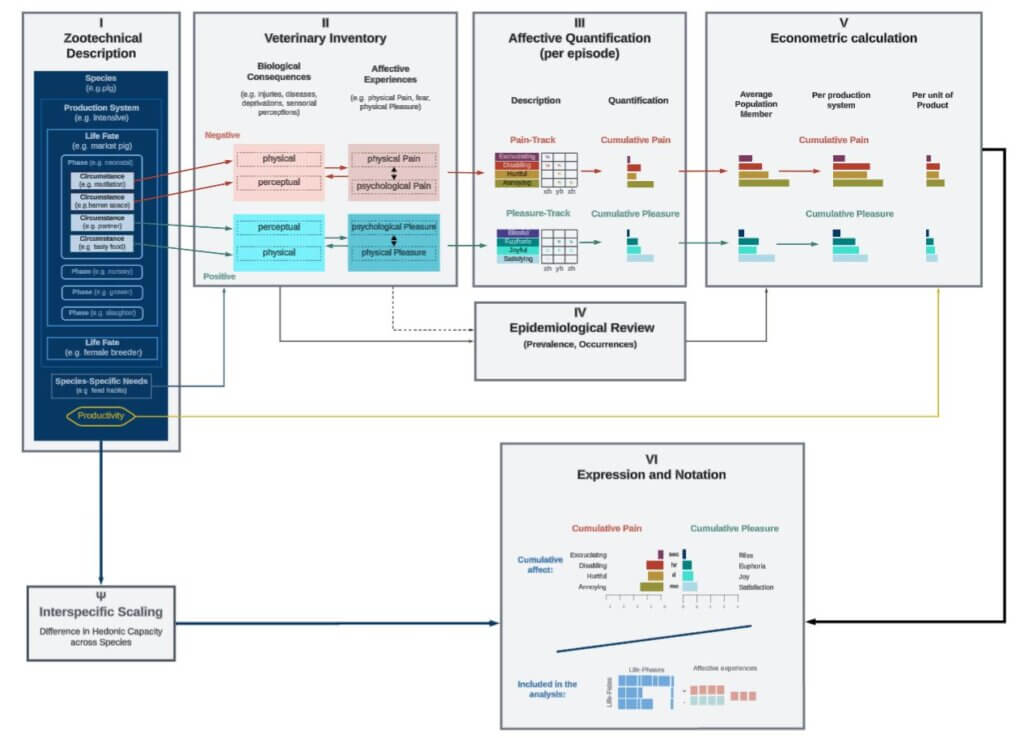
I. Zootechnical Description
Describes the physical, social, environmental, genetic, and management conditions—referred to as Circumstances—to which animals are typically exposed. This is done hierarchically by Life-Fate (e.g., market animal, breeder) and Life-Phase (e.g., rearing, transport), tailored to each species and production system.
II. Veterinary Inventory
Identifies the Biological Consequences (e.g., injuries, diseases, deprivation) resulting from Circumstances. These outcomes can be physical or psychological and serve as proximate causes of affective experiences.
III. Affective Quantification
Quantifies the magnitude of welfare impacts by:
IV. Epidemiological Review
Estimates the prevalence and frequency of each affective experience in the population. This allows the translation of individual-level Cumulative Pain and Pleasure into population-level estimates, reflecting the average burden per animal.
V. Econometric Calculation
Aggregates the Cumulative Pain and Pleasure of all animals in a system and standardizes it by productivity indicators (e.g., per kilogram of meat, per dozen eggs). This enables comparison across products, systems, and interventions.
Ψ. Interspecific Scaling
Provides an optional, post-quantification adjustment mechanism for comparing species. Because the core framework is intentionally agnostic about interspecific differences, any assumptions regarding a species’ hedonic capacity (the ability to experience affective states) or moral weight must be applied explicitly and transparently at this final stage, rather than being implicitly folded into the core estimates.
VI. Welfare Footprint Expression and Notation
Standardizes how results are communicated. A complete Welfare Footprint includes:
Publication status.
The core methodological paper describing the Welfare Footprint Framework is currently under review at Animal Sentience. Until the journal version is published, readers should cite the OSF preprint:
Alonso, W. J., & Schuck-Paim, C. (2025). Welfare Footprint Framework: Methodological Foundations and Quantitative Assessment Guidelines. Center for Welfare Metrics (São Paulo). https://doi.org/10.17605/osf.io/94bxs
This version contains the full framework, notation standards, and methodological guidelines.
The video on the left summarizes the approach, and the video on the right is a presentation, by our Research Director, explaining the method in more detail. The video on the bottom is a presentation of the general analytical framework to calculate Welfare Footprints.