Kaitlin Wurtz, Cynthia Schuck-Paim
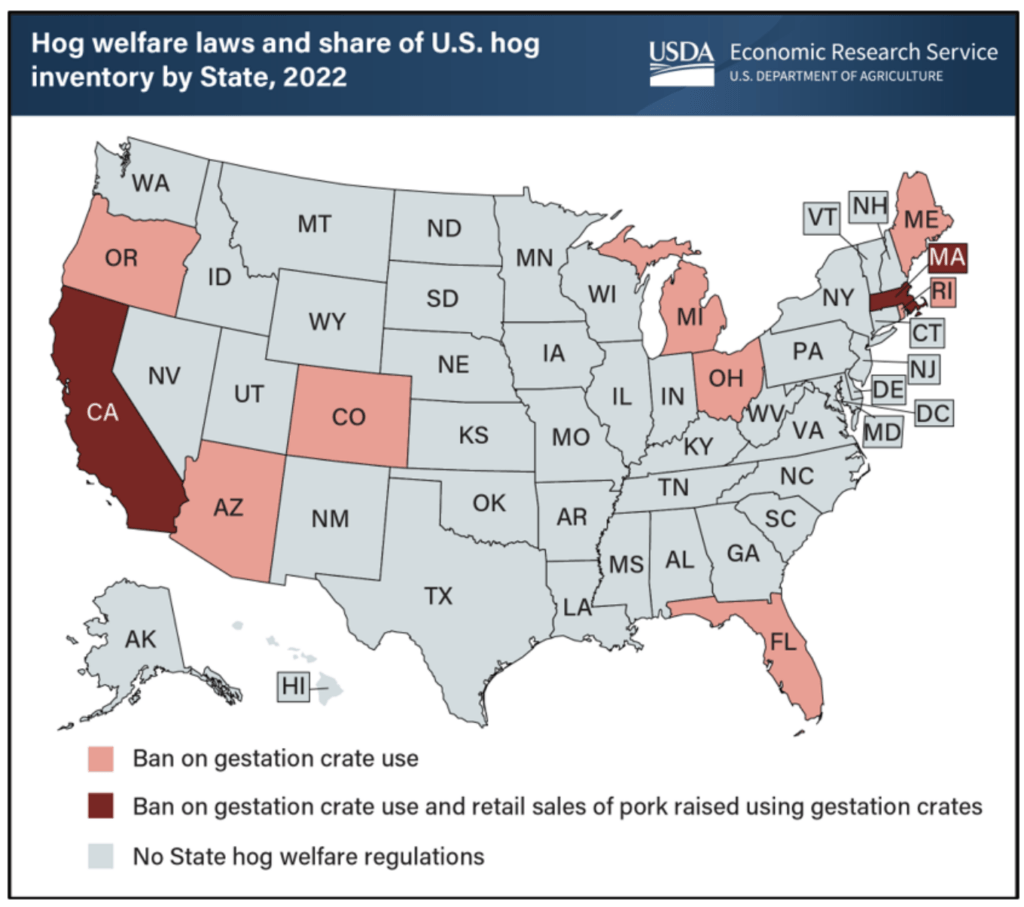
The housing of gestating sows has become one of the most debated animal welfare reforms in U.S. livestock production, especially as gestation stall bans are being implemented in a growing number of states across the country. These bans are largely driven by consumer ethical concerns and legislation, as well as evolving scientific knowledge on the welfare consequences of crate housing.
Historically, gestation stalls were adopted as the swine industry consolidated and intensified production, providing benefits to producers such as reduced labor costs, ability to control individual rations, and reduced injuries due to fighting (Estienne and Harper 2003). In more recent years, societal concern over prolonged periods of intense confinement have grown (Ryan et al. 2015; Yunes et al. 2018). Growing scientific literature lends support to these concerns through evidence of negative impacts to sow physical and psychological health (Mcglone et al. 2004). Most notably, confinement in gestation stalls is associated with high levels of stereotypic behavior and gastric ulcers, suggesting chronic stress, boredom, and frustration from their inability to turn around or perform highly motivated species-specific behaviors. Their restricted ability to move and prolonged lying time also contribute to high prevalence of structural issues and skin lesions resulting from extended contact with the flooring or metal stall components.
According to the most recent USDA National Animal Health Monitoring System (NAHMS) Swine survey (2021-22), about 58% of U.S. large-enterprise operations house gestating sows in stalls, and the remainder in group systems. While the latter provide many benefits such as greater space to move around and the ability to engage in social interactions, they also come with their own challenges. Aggression associated with the mixing of unfamiliar sows, lameness, injuries related to social conflict, and restricted feed access for subordinate animals are consistently identified as major risks to welfare. Because the welfare impacts associated with gestation stalls and group housing differ in nature and are not directly comparable using conventional indicators, assessments have often focused on isolated outcomes and performance rather than addressing how welfare harms across systems trade off against one another (Chou and Parsons 2022). This has made it difficult to determine, in a way that is meaningful for policy and decision-making, the overall welfare impact of transitioning between gestation housing systems.
Additionally, assessing sow welfare across gestation housing systems is methodologically complex. As noted by H. Gonyou (personal communication, cited in (Bench et al. 2013)), “when all of the feeding, grouping, and timing methods are taken into consideration, there are in the region of 72 possible options of how to manage gestating sows”. This heterogeneity complicates direct, scientific comparison of housing systems. Further, when comparing stalls with group systems, challenges arise as the appropriate statistical unit often differs (individuals compared to entire groups), making controlled, replicated experiments logistically difficult and costly.
The Welfare Footprint Framework (WFF) provides a common and relatable scale on which welfare consequences of different nature can be assessed and compared. By translating diverse welfare impacts into a common currency, time spent in specific affective states, the framework allows for meaningful comparisons of housing systems that differ fundamentally in their welfare impacts.
This project applies the WFF to assess the welfare impact of the ongoing transition from gestation stalls to group housing systems in the United States, the third-largest producer of pork globally, currently undergoing a widespread structural change in gestation housing driven by legislative mandates and market pressures. The analysis compares a standardized gestation stall system with a set of group housing scenarios that reflect commercially relevant U.S. practices, ranging from systems that incorporate widely recognized best practices to systems that reflect more typical or minimally optimized implementations. By quantifying how overall welfare outcomes vary across these scenarios, the analysis also allows assessment of the extent to which the welfare consequences of crate-free transitions depend on how group housing is implemented in practice.
Over 50 negative and positive affective experiences are quantified for each scenario. Because the Welfare Footprint Framework quantifies welfare in terms of affective states rather than diagnostic categories, conditions may be grouped according to the nature, intensity, and duration of the experiences they produce rather than their underlying pathology.
We welcome your ideas and expertise. If you have a suggestion or would like to contribute to this project, please complete this form. We will review your submission and contact you with information about next steps.