Patricia Pereira, Benjamin Wilden, Monica Osorio, Cynthia Schuck-Paim
Whiteleg shrimp are the world’s most farmed aquatic animals, with hundreds of billions produced every year. Considering growing evidence that decapod crustaceans, the group that includes shrimp, crabs, and lobsters, are capable of experiencing pain and other affective states, the welfare implications of shrimp farming at this scale are potentially enormous.
Yet knowledge of shrimp welfare remains extremely scarce. We still know relatively little about what good welfare looks like for shrimp, key welfare challenges in intensive systems, and how to detect welfare problems before they become severe.
In this project, commissioned by the Shrimp Welfare Project, our goal is to help build this understanding, and explore potential indicators of shrimp welfare that could be monitored at the farm level. Using the Welfare Footprint Framework (WFF), we have therefore investigated the biology and natural ecology of the species to identify species-specific needs that remain relevant in a farming context. We then examined the Circumstances imposed by intensive farming, mismatches with those needs, and the Biological Consequences most likely to arise as a result. Welfare indicators should reflect the most impactful biological consequences experienced by the animal, rather than simply what is easiest to measure.
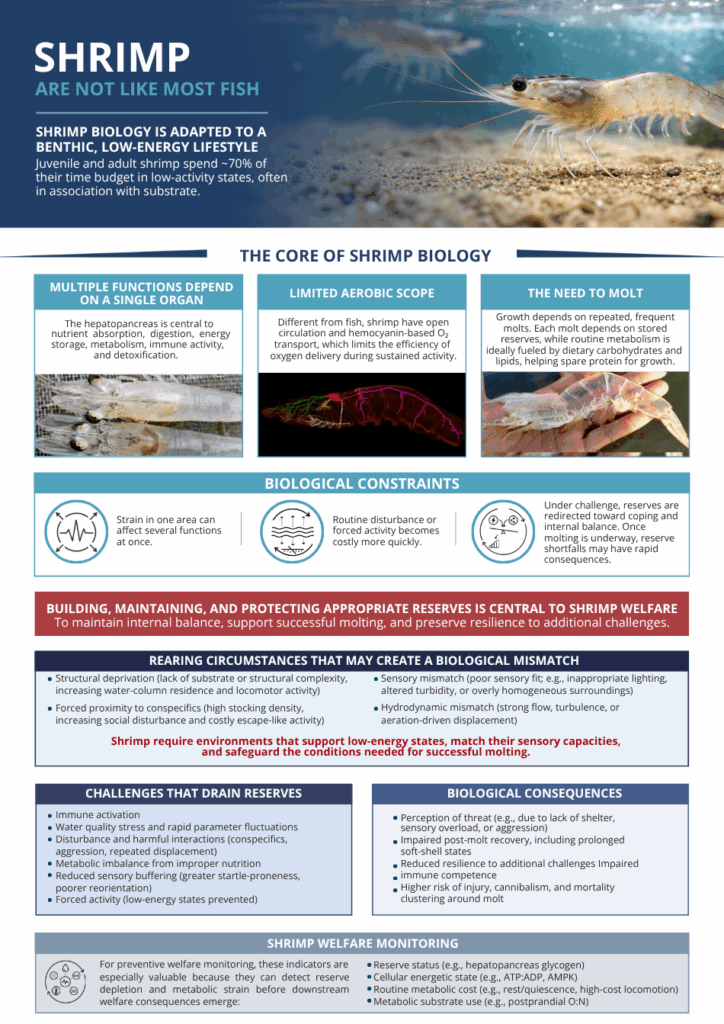
Their biology appears adapted to an epibenthic, low-energy way of life. Evidence suggests that juvenile and adult shrimp spend most of their time in low-activity states, often in close association with the substrate, whether natural or artificial. This matters because it suggests that rest, low routine activity, and stable contact with the environment are central to how the species lives.
This is also why substrate should not be treated as unimportant simply because whiteleg shrimp are not a classic deep-burrowing species. Indeed, the evidence points to several plausible biological functions fulfilled by access to substrate or other surfaces: structured rest and circadian regulation, protection during periods of molt-related vulnerability, spatial segregation from conspecifics, foraging and nutritional enrichment, and ongoing tactile and sensory engagement with the environment.
Key features of shrimp biology explain why substrate-associated, low-activity states are such a dominant part of shrimp life.
First, shrimp have a limited capacity for sustained activity. Unlike fish, they have an open circulatory system and use hemocyanin, rather than hemoglobin, to transport oxygen. This makes oxygen delivery during prolonged activity less efficient, which helps explain why they are not adapted for sustained active swimming. It also means they may become fatigued more quickly when repeatedly disturbed or forced to move, especially when this triggers tail flips, their signature escape response, which is extremely energy-demanding.
Second, shrimp grow through molting, a process that depends heavily on glycogen and lipid reserves accumulated in advance. These reserves function as a shared energetic buffer that must simultaneously support immune function, stress responses, and the demands of the molt cycle itself. Under normal conditions, dietary carbohydrates and lipids meet routine energetic requirements. However, when intake is insufficient or energetic expenditure increases due to environmental challenges, stored reserves are mobilized to compensate. Protein serves as a final metabolic fallback when these reserves become depleted, but its use is costly: protein breakdown is energetically inefficient, generates ammonia as an obligatory (and toxic) byproduct, and diverts resources away from the physiological processes required for successful molting. Thus, under optimal conditions, protein should be spared for cuticle synthesis and somatic growth.
This energetic constraint is amplified by the structure of the molt cycle itself. Shrimp spend much of the cycle either preparing for molt or recovering from it, while the truly stable intermolt phase appears to make up only a relatively small share of the cycle (about 22%). This is important because the most vulnerable stages, from late premolt through the early post-molt period, depend heavily on stored reserves as feeding declines and ceases. In this sense, molting removes the luxury of time: if additional challenges arise, reserves may be diverted toward coping and maintenance, and reserve shortfalls can have rapid consequences, because once the hormonal molting cascade has started, it cannot be postponed.
Third, many of shrimp’s biological functions depend heavily on a single organ: the hepatopancreas. This organ is central to digestion, nutrient absorption, energy storage, intermediary metabolism, immune-related activity, and detoxification. Because so many critical functions are concentrated in one organ, the hepatopancreas is both a bottleneck and a single point of failure. Consequently, strain on any one function can compromise the organ’s overall capacity and impair several others at once. This also means that the shrimp’s energetic budget is tightly interconnected. For example, if excessive energy is diverted toward intermediary metabolism, such as during increased protein breakdown, fewer resources remain available for reserve accumulation, immune function, growth, and successful molting.
In summary, whiteleg shrimp is especially vulnerable to conditions that repeatedly disrupt low-energy states, increase routine activity, or deplete reserves. Shrimp welfare is therefore highly likely to depend heavily on the ability to build, maintain, and protect adequate reserves.
Four features of the rearing environment emerge as especially relevant:
Other farming conditions may add to the same energetic strain. Poor water quality, rapid fluctuations in salinity or other parameters, unsuitable diet composition, and disease challenge can all increase the energy shrimp must spend to keep functioning
Several common features of intensive rearing are likely to work synergistically to create a chronic energetic mismatch. In other words, intensive rearing environments may steadily increase the shrimp’s day-to-day energy demands while also making it harder to build and protect the reserves needed for growth, immune function, and successful molting. This may also leave them with a smaller energetic buffer when new challenges arise. Multiple downstream problems may follow, including impaired molt recovery, prolonged soft-shell states, reduced immune competence, greater susceptibility to disease, and a higher risk of injury or cannibalism. Mortality clustering around molt may be one especially important sign that shrimp are failing to cope with the combined demands placed on them.
The research so far suggests that the best indicators are not always the most obvious ones. In intensive farming contexts, disease, failed molts, injury, and mortality are important, but they are late signs that something has already gone wrong. If the goal is prevention, the most useful indicators are likely to be the ones that detect problems earlier. Given how central energetic state is likely to be to whiteleg shrimp welfare, the most informative indicators are likely to be those that detect deviations in reserve status, cellular energetic state, routine metabolic cost, or metabolic substrate use before downstream welfare consequences emerge. Examples include hepatopancreas glycogen, AMPK or ATP:ADP, rest or quiescent states and frequency of high-cost locomotion, and postprandial O:N (namely oxygen consumption to nitrogen excretion ratio, reflecting the degree to which the animal has been forced into a costlier metabolic mode dominated by protein breakdown that inherently signals reserve depletion), respectively.
The extent to which these indicators can be monitored in commercial conditions, however, is under investigation. Different farming systems create different constraints. Water may be clear or turbid. Behavioral tracking may or may not be possible. Laboratory analysis may not be routinely available. And in a species where deterioration can become visible quickly, especially around molt, indicators need to be monitored often enough to provide an early warning.
In whiteleg shrimp, welfare in intensive systems is likely to rely heavily on whether shrimp retain enough energetic margin to cope with everyday demands, support immune function, and successfully complete molt. Intensive conditions tend to deplete that reserve. Protecting welfare means detecting strain early, before it manifests as failed molts, injury or disease, and changing the conditions that erode these reserves in the first place.
Disclaimer: This is an ongoing project and the findings presented here reflect the current state of the research; conclusions and recommendations may be refined as new evidence emerges.