
Pleasure Intensities

Technical Definitions

Full definitions of pleasure intensity levels

Satisfaction.

Summary. Low-intensity positive states in which the individual shows subtle signs of comfort or satisfaction associated with a physical sensation or with the meeting of a non-essential need.

Operational descriptors:

  • Character of the state: low-intensity positive affect; subtle signs of comfort or satisfaction.
  • Typical triggering contexts: physical sensations or the meeting of non-essential needs. Source examples include comfortable bedding conditions, grooming, and basking in the sun.
  • Engagement: present but not overwhelming. The individual can easily shift attention to other stimuli or activities as needed.
  • Attention to surroundings: preserved. The individual remains aware of, and responsive to, other stimuli.
  • Overt expression of Pleasure: subtle; not prominent.
  • Physiological correlates: not emphasized at this level in the source.

Distinguishing character. Positive affect is present and detectable through subtle behavioral and contextual cues, but the engagement is light enough that the individual remains free to redirect attention to other stimuli or activities. The state does not preempt other behaviors.
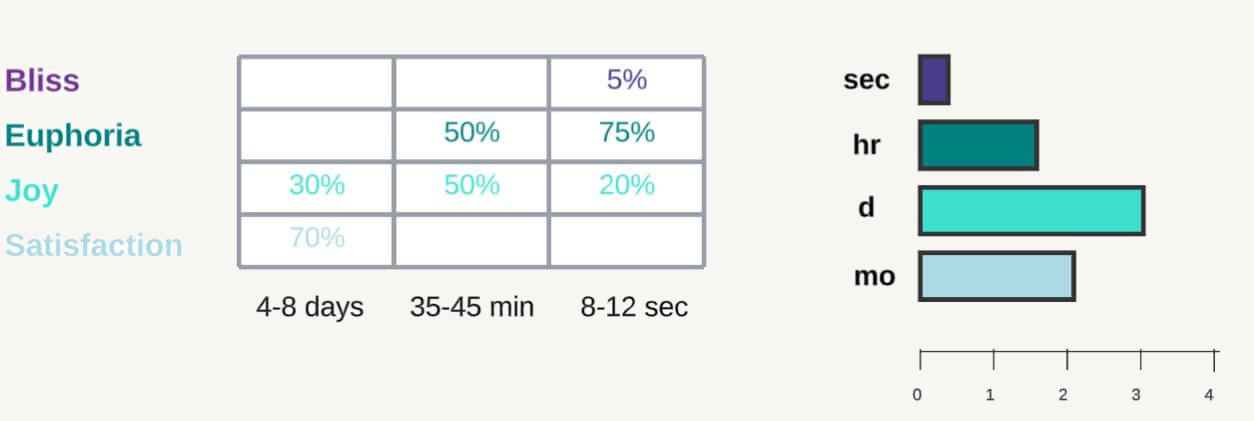
Joy.

Summary. Positive states involving greater engagement in rewarding activities, with behavior noticeably directed toward maintaining or enhancing the positive experience, yet without that experience exclusively dominating the individual's attention.

Operational descriptors:

  • Character of the state: moderately intense positive affect with greater engagement than Satisfaction.
  • Typical behavioral manifestations: enhanced vigor in play, stronger social bonding, more active engagement in highly preferred activities such as foraging.
  • Direction of behavior: noticeably directed toward maintaining or enhancing the positive experience.
  • Focus: greater focus on the positive experience, while still not exclusively dominating attention.
  • Physiological correlates: heightened autonomic responses may be present (e.g., heart rate), per the source.
  • Overt expression of Pleasure: more visible than at Satisfaction, including more energetic engagement and social affiliative behaviors; not yet at the level of spontaneous, expressive vocalizations characteristic of Euphoria.

Distinguishing character. The individual is now visibly motivated to maintain or enhance the positive experience, but the experience does not exclude responsiveness to other relevant stimuli.

Euphoria.

Summary. Intense positive states in which the positive experience becomes the primary focus of attention, with everything else seeming secondary for the duration of the experience.

Operational descriptors:

  • Character of the state: intense positive affect; the positive experience is the primary focus of attention.
  • Typical contexts: immersive play, mating rituals, and the pursuit and enjoyment of highly favored resources. The primary source supplies a successful hunt as an illustrative example of such contexts; this is a source example, not a WFI normative endorsement of any particular activity.
  • Focus: other stimuli and activities tend to seem secondary while the state is active.
  • Overt expression of Pleasure: in some situations, this intense state may lead to spontaneous expressions of Pleasure, such as vocalizations.
  • Physiological correlates: further heightened relative to Joy where available; not exhaustively specified by the source.

Distinguishing character. The shift from Joy to Euphoria is characterized by the positive experience becoming the primary, rather than merely the directed, focus of attention. Spontaneous expressive behavior may, but need not, appear.

Bliss.

Summary. A profound positive state that pervades sensory and emotional experience and, for its duration, eclipses other immediate needs and environmental stimuli. The source describes Bliss as expected to be rare and of short duration.

Operational descriptors:

  • Character of the state: profound positive affect; pleasure pervades the individual's sensory and emotional experience and transcends ordinary positive states.
  • Effect on attention to other needs and stimuli: the degree of positive engagement is so intense that other stimuli and immediate needs are strongly backgrounded for the duration of the experience. The primary source describes this state as one in which the individual is consumed by an all-encompassing sensation, eclipsing other immediate needs or environmental stimuli.
  • Typical contexts (source examples): orgasmic states, reuniting with socially significant partners after prolonged separation, or the encounter of extremely positive conditions after prolonged periods of stress and hardship.
  • Source-stated temporal expectation: Blissful states are expected to be rare and of short duration.
  • Overt expression of Pleasure: may be highly expressive, but its presence or absence does not, by itself, settle the inferential question.

Temporal-expectation caution. The source-stated rarity and short duration of Bliss is an expectation about how this state is typically realized, not a derived methodological rule about the temporal limits of high-intensity affect in general. It should not be mechanically mirrored onto the Pain side; the Pain-side category Excruciating has its own source-stated temporal characterization (not normally tolerated for more than seconds), and the two should not be conflated. The structural asymmetry between Bliss and Excruciating is treated in §10.

Methodological caution. Attribution of segments to Bliss must be made cautiously. Bliss should be reserved for positive intensity profiles supported by converging evidence, consistent with the source-stated rarity of the state.

Pleasure intensity categories

Summary of the four pleasure intensity categories: Satisfaction, Joy, Euphoria, and Bliss.